E-commerce Trends: What Gen Z and Millennials Expect from Online Shopping Right Now
Unpacking the main trends in fashion e-commerce. How customer behavior has changed, and why implementing AI and Virtual Try-On (VTO) reduces return rates and boosts sales.
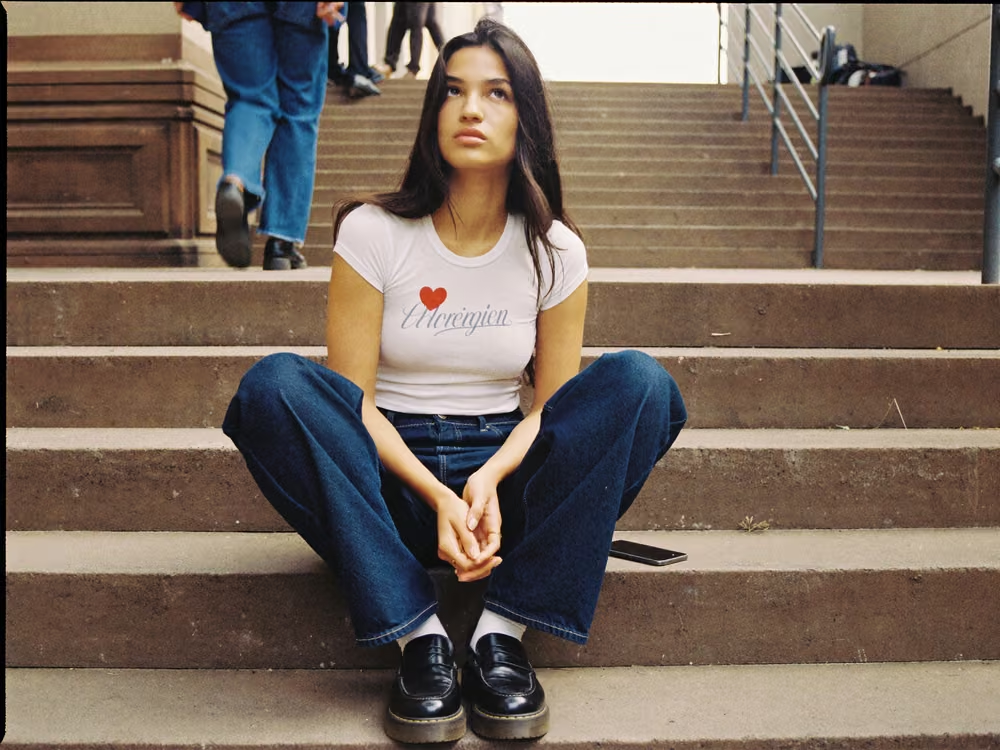
The rules of the game in fashion retail have changed. If five years ago it was enough for an online store to have easy navigation, fast delivery, and high-quality studio photos, today this basic hygiene no longer guarantees sales. The main share of the solvent audience consists of Millennials (Generation Y) and Zoomers (Generation Z). These are digital natives whose consumer habits differ radically from the patterns of previous generations.
For fashion brand owners and e-commerce directors, this means one thing: old sales funnels are failing. Customer Acquisition Cost (CAC) is steadily rising, the conversion rate from product page to purchase is dropping, and the logistics of returns eat up the lion's share of margins. Users no longer want to just "buy things"—they demand a personalized, interactive, and seamless digital experience that rivals social networks in terms of engagement.
Let's break down what technologies and mechanics determine the success of an online store today, and why the lack of interactivity in 2026 is a direct path to losing market share.
1. Agentic AI and Hyper-Personalization Without Manual Filters
Millennials and especially Gen Z do not like to waste time scrolling through endless catalogs. The standard "category – color – size – price" filtering system is morally obsolete. The buyer thinks in scenarios, not in SKUs.
Instead of searching for "women's summer midi dress," the user wants to type a query: "what to wear to a friend's wedding in August if the dress code is cocktail and my budget is up to $150."
This is where Agentic AI comes into play—algorithms that do not just offer products from the "Frequently bought together" category, but act as a digital stylist. They analyze browsing history, query context, seasonality, and even the customer's geolocation, generating ready-made capsule wardrobes.
What this gives the business:
- Average Order Value (AOV) Growth: The customer buys a complete look rather than a single item.
- Lower Bounce Rate: The user immediately sees a relevant selection and does not leave for competitors due to decision fatigue.
2. Immersive Experience and Virtual Try-On (VTO) — The New Industry Standard
The main barrier in online shopping is the inability to try an item on. A photo of a model on a white background, no matter how high-quality, does not answer the buyer's main questions: "How will these glasses look on my face?", "Does this bag look too bulky for my height?", "Will this shade of lipstick or metal suit me?".
Virtual Try-On is no longer a PR toy for large corporations. Today, it is a working performance tool that directly affects unit economics.
The Psychology of Purchasing and the "Endowment Effect"
From a neuromarketing perspective, when a customer sees a product on themselves (via a smartphone camera), the "endowment effect" is activated in their brain. Subconsciously, the person begins to perceive this item as their own. The barrier to parting with money drops sharply. Visualization closes the need for tactile contact with the product.
Why Web-AR Beats Mobile Apps
A common mistake many brands make is developing their own heavy app just for the try-on functionality. Gen Z is extremely reluctant to download new apps for a one-time purchase. Speed is crucial for them: saw an ad — went to the site — tried it on — bought it.
That is why the integration of widgets based on Web-AR (augmented reality in the browser) shows the highest efficiency. For example, the Looksy service allows you to embed virtual try-on directly into your online store's product cards.
How Looksy solves B2B pain points:
- Multi-category support: The widget supports trying on clothes, glasses, jewelry, bags, and accessories. You do not need to look for different contractors for different types of products.
- Accuracy and realism: Computer Vision algorithms track facial expressions, lighting, and body proportions. Jewelry glares correctly, glasses sit exactly on the bridge of the nose, and bags are displayed in real scale.
- Seamless integration: Installing the widget does not require rewriting the site's architecture. It is a SaaS solution that starts working and generating ROI in the shortest possible time.
3. Reverse Logistics: How to Stop Losing Money
For fashion business owners, the Return Rate is a metric that is not spoken about loudly, but which can destroy any financial model. In the apparel and footwear segment, the return rate often reaches 30-40%.
Table: The Hidden Costs of Every Return
|
Expense Item |
Cost Description |
|
Logistics |
Paying for return shipping to the warehouse, courier services. |
|
Warehouse Operations |
Receiving, inspecting for defects, repackaging, returning to the shelf (often requires manual labor). |
|
Lost Profit |
While the item is traveling back and forth, another customer cannot buy it (especially critical for seasonal collections). |
|
Markdown |
Damaged packaging or signs of wear force the product to be sold at a discount. |
Gen Z and Millennials frequently use the "bracketing" strategy — ordering one item in three adjacent sizes or colors, knowing in advance that they will return two of them.
Implementing VTO solutions breaks this pattern. By giving the customer the ability to interactively try on an item via camera, the store removes uncertainty. Practice shows that the integration of virtual try-on reduces the number of returns due to "wrong style/size/color" by 15–25%. On an annual scale, this represents colossal savings in operational costs.
4. Social Commerce and the Seamless Checkout
Gen Z does not search for products via traditional search engines — they look for them on TikTok, Instagram Reels, and YouTube Shorts. The content must be dynamic, authentic, and native.
But the main demand of the younger generation is a seamless transition from content to purchase. If a user sees a cool bag in a video, they should be able to buy it in two clicks, preferably without leaving the familiar environment, or by transitioning to a site with instant loading and Apple Pay/Google Pay support.
What needs to be implemented:
- User Generated Content (UGC) in product cards: Photos of real buyers convert better than perfect studio shots.
- Video reviews: Short clips demonstrating fabric, fit, and details in motion.
- Zero-click purchases: Optimizing the shopping cart to the point where the customer does not need to enter dozens of fields with addresses and zip codes.
5. Omnichannel 3.0: Blurring the Lines Between Online and Offline
The concept of omnichannel has evolved. Now it is not just "order on the site — pick up in-store." Gen Z practices "webrooming" (choosing a product online, buying in an offline boutique) and "showrooming" (trying on in-store, ordering on a site where there is a discount).
Brands that understand this specific behavior turn their physical locations into experience centers, and their websites into interactive extensions. Using augmented reality technologies bridges these two worlds. For example, a customer can scan a QR code in an offline store if their size is out of stock, try on a different color in AR format, and immediately arrange for home delivery.
6. Sustainability: Conscious Consumption as a Business Factor
For Generation Z, brand sustainability is not an empty buzzword, but a real factor in making a purchasing decision. They check how ethically clothing is produced and prefer companies that care about reducing their carbon footprint.
How does this relate to e-commerce metrics? Directly. Product returns, which we discussed earlier, generate millions of tons of CO2 annually due to additional logistics and packaging.
By positioning the implementation of virtual try-on not only as a convenience but also as a step toward reducing the carbon footprint (fewer test orders = fewer emissions from courier vehicles), a brand earns massive reputational points in the eyes of a young audience. This builds loyalty and increases Customer Lifetime Value (LTV).
Checklist for Fashion Brand Owners: Is Your Store Ready for the New Reality?
Evaluate your online store against the following criteria:
- Level of visualization: Do you offer only static product photos, or are there videos/3D models/virtual try-on capabilities?
- Depth of personalization: Are product recommendations based on real user behavior, or is it a static "Popular" block?
- Mobile experience: Does your site work as quickly and smoothly in a mobile browser as it does on desktop?
- Return rate: Do you track the reasons for returns and use technological tools to minimize them?
- UGC Integration: Can the customer see how the item fits on real people in the product card, rather than just professional models?
Conclusion
The era of classic catalogs is a thing of the past. In conditions of fierce competition for user attention (the attention economy), the e-commerce projects that win are those that offer not just a product, but an exceptional user experience.
The expectations of Zoomers and Millennials are shaped by social networks and streaming platforms — they want interactivity, speed, and personalization. Implementing AI search and AR technologies is no longer an attempt to surprise the customer, but a harsh necessity to keep conversion rates at a profitable level.
Stop losing profit on abandoned carts and reverse logistics fees just because the customer "didn't understand how it would look." Give buyers confidence in their choices. Install the Looksy virtual try-on widget — integrate innovation into your online store and start increasing your audience's conversion and loyalty today.
Request a LOOKSY Demo
Submit a request, and we will help you choose the LOOKSY format that best fits your business case.