Virtual Clothing Try-On. How Fashion Stores Can Sell Looks, Not Just Pictures
Discover how to turn buyers from observers into active participants. Learn how to multiply conversion rates, engagement, and average order value using generative neural networks and the Looksy AI widget.
The fashion e-commerce market is overheated. Customer Acquisition Cost (CAC) is steadily growing year by year, advertising auction bids are breaking the ceiling, and the competition for user attention is measured in seconds. In this reality, driving targeted traffic to an online store is only a fraction of the challenge. The main hurdle for brand owners and retailers is retaining that attention and converting it into a paid order.
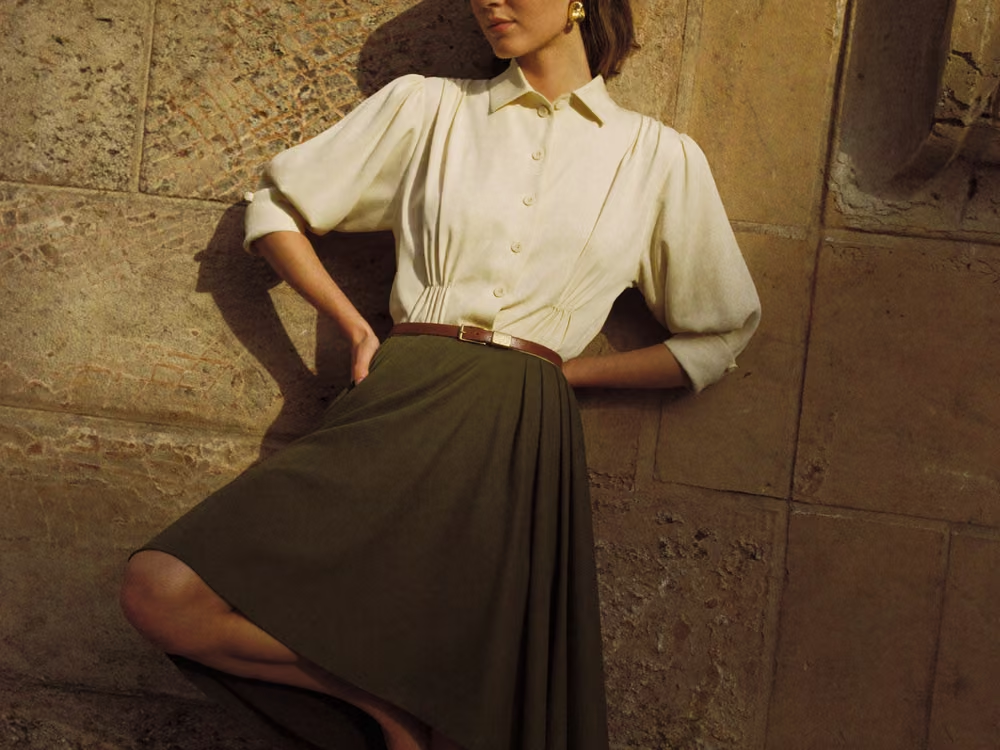
Standard methods of interacting with a catalog are rapidly losing their effectiveness. Buyers are accustomed to flawless visuals: professional studio shoots, calibrated lighting, retouching, and models with perfect proportions have become the baseline norm. However, this norm no longer generates explosive sales growth. The user sees a beautiful picture but cannot associate it with themselves. A barrier of perception arises.
The paradigm shift in e-commerce dictates new rules: today, the winning platforms are those that transition from a showcase display of single items to selling personalized outfits (Total Look). The key instrument in this transformation is the implementation of generative neural networks and AI widgets, such as Looksy. This technology shifts the customer from a passive observer into an active participant in creating their own style, which acts as a powerful driver for conversion growth.
The Evolution of Fashion Catalogs: Why Standard Visuals No Longer Convert
To understand the mechanics of virtual try-on, it is essential to analyze why traditional product presentation methods fail at the decision-making stage.
Blindness to Studio Photographs
The human brain adapts to information noise. Similar to banner blindness, a phenomenon of "catalog blindness" has formed in e-commerce. The customer scrolls through dozens of product cards, filtering out polished images. A studio photograph is perceived as abstract promotional material rather than a real product that can be integrated into everyday life. The user subconsciously understands that an item on a professional model, under softbox lighting, will look entirely different than it will in reality.
The Gap Between Expectation and Self
The fundamental problem with a classic catalog is the lack of personalization. A buyer is not just purchasing a piece of fabric cut to specific patterns. They are buying an answer to the question: "How will I look in this?" A photograph of a model on a white background ignores this question. A cognitive distance emerges: the customer evaluates the appeal of the item itself but cannot project that image onto their own figure, color type, and unique features. Doubts accumulate, and as a result, the item is left in an abandoned cart.
The Trend Towards Hyper-Personalization
The modern consumer expects a brand to adapt to their individuality. Stores that offer a unique visual interaction experience build a deeper connection with their audience. Personalization is no longer just about adding a first name to an email newsletter; it is now about providing an individual context for every item in the catalog.
Emotional Commerce: The Mechanics of Selling a Cohesive Style
The decision to purchase in the fashion segment is rarely based solely on rational factors. Yes, fabric composition and seam quality matter, but the primary impulse is always emotional. A shopper is not looking for a dress—she is looking for self-confidence, status, comfort, or admiring glances.
Virtual try-on acts as a catalyst for emotional commerce. The ability to instantly "wear" a digital copy of an item over one's own photograph creates a powerful psychological anchor.
- Endowment effect: As soon as a person sees an item on themselves, even on a smartphone screen, brain processes associated with actual ownership are triggered. Parting with the product (closing the tab) becomes psychologically more difficult.
- Reduced cognitive load: The customer no longer has to strain their imagination trying to picture how an emerald green blouse will match their skin tone. The AI provides a ready-made visual answer in fractions of a second.
As a result, a strong emotional attachment to the product is formed even before the mouse cursor hovers over the "Add to Cart" button.
Technological Leap: How Neural Networks are Shaping the New UX
Modern virtual try-on differs drastically from the primitive AR masks of five years ago, which simply overlaid a flat image on top of a face or body. The Looksy service is powered by complex generative artificial intelligence architectures.
Neural networks analyze the user's uploaded photograph, recognizing anthropometric points, posture, body geometry, and original lighting. Then, seamless rendering occurs: the clothing is not just "glued" to the silhouette; it wraps around it, accounting for the physics of fabrics. The AI understands how silk should drape, where folds form on heavy denim, and how knitwear adapts to the curves of the figure.
From a Single Item to an Outfit Ecosystem (Total Look)
The key competitive advantage of integrating the Looksy widget lies in its multi-product approach. Modern try-on is not an isolated test of a single jacket. It is an opportunity to assemble a complete wardrobe ensemble right within the store's interface.
The algorithms allow the combination of various product categories:
- Base layer: Dresses, suits, shirts, trousers.
- Accessory group: Bags of various styles and sizes (from clutches to shoppers).
- Eyewear: Sunglasses and frames, where the neural network takes into account the bridge fit, facial proportions, and even lens glare.
- Jewelry and bijouterie: Earrings, necklaces, rings, watches.
The buyer no longer has to put the puzzle together in their head. They see a complete, finished look on their own photograph.
Comparative Analysis of User Experience
Parameter | Traditional E-commerce Catalog | Catalog with Integrated Looksy AI Widget |
Level of Personalization | Zero. All customers see the exact same model. | Maximum. The product is showcased on the specific buyer's photo. |
Perception of Dimensions | The customer has to rely on text descriptions for sizing. | Visual understanding of the proportions of a bag or glasses relative to the user's body/face. |
Combinatorics | Requires opening multiple tabs and mentally combining items. | Creation of a cohesive outfit (Total Look) within a single widget window. |
Emotional Response | Low (passive observation). | High (wow effect, gamification, personal try-on). |
Direct Correlation: How AI Try-On Hacks Conversion Metrics
The implementation of technological innovations in e-commerce must pay off in measurable business metrics. A virtual try-on widget is not an image-building "toy" for entertaining the audience, but a hardcore performance tool that directly impacts the sales funnel and the project's unit economics. Let's examine the mechanics of Looksy's impact on key metrics.
Increased Time on Site and Gamification
User attention is the most valuable resource. The virtual try-on process introduces an element of gamification into the routine shopping process. Customers become interested in experimenting: "How will I look in these aviator glasses? What if I add this red bag?"
Users start spending 2 to 3 times longer on catalog pages. From a marketing perspective, this creates a dual effect. First, engagement grows, warming up a cold visitor into a hot lead. Second, behavioral factors (longer sessions, active clicks) send a strong positive signal to search engine algorithms. The site's SEO metrics improve organically, leading to an increase in free search traffic.
Growth in Page Depth
This metric is closely tied to the previous point. A typical user scenario: clicked on a product card from an ad, looked at it, and left. The scenario with AI try-on: clicked on the card, tried the item on, and the system suggested completing the look with a bag from the new collection. The customer moves to the bags section, then to the jewelry section. The depth of visit (the number of pages visited per session) multiplies, dropping the Bounce Rate to a minimum.
Cross-Sell, Upsell, and Maximizing Average Order Value (AOV)
This is where the main financial potential of selling looks rather than pictures lies. When a store sells items in isolation, the customer focuses on a single need (e.g., buying a coat).
The Looksy widget enables the most native and effective cross-selling mechanics. In the try-on interface, the buyer sees that the chosen coat harmonizes perfectly with a silk scarf and oversized sunglasses from your own inventory. Because the customer sees this ensemble on themselves, the perceived value of the additional accessories skyrockets.
The probability that three or four items will go into the cart instead of just one increases significantly. You boost your Average Order Value (AOV) without additional spending on retargeting or aggressive discount campaigns. You simply give the customer the tool to create their perfect style.
Eliminating the First-Step Barrier and Boosting Conversion Rate (CR)
The biggest enemy of conversion is doubt. "Will this cut suit me? Won't these frames be too wide for my face? Does this color match my type?" These questions generate friction along the Customer Journey. If the customer does not find the answers, they leave to think about it and generally do not return.
Generative AI destroys this barrier. Visual confirmation that an item fits perfectly transforms doubt into confidence. The fear of making the wrong choice is eliminated. Customer confidence converts into a swift, decisive click on the buy button. The percentage of completed transactions relative to the total number of site visitors (CR) demonstrates a steady positive dynamic.
Implementation Architecture: Transparent Connection of the Looksy Widget
Many fashion business owners are apprehensive about adopting complex AI tools, assuming it will require months of development, restructuring database architectures, and hiring a team of programmers. The Looksy service is designed with the needs of the B2B segment in mind, where Time-to-Market is of critical importance.
- Optimized integration process: Connecting the widget to an online store happens in the shortest possible time. It is a modular solution that embeds into the existing site code using ready-made scripts or APIs.
- Seamless UX: The widget organically integrates directly into the product card interface. The buyer does not need to download third-party apps, navigate to other domains, or register in new systems. The entire process of creating an outfit takes place within your ecosystem, preserving brand integrity.
- Delegating computing power: Processing photographs, rendering textures, and running generative neural networks require colossal server resources. Looksy takes this load onto its own cloud clusters. Your website continues to operate just as fast as before, without losing page load speed.
The Future of Fashion Retail: Adaptation or Stagnation
The e-commerce market is unforgiving of technological lag. The tools that seemed like innovations for industry giants yesterday are becoming mandatory hygienic minimums for brands of any scale today. Buyers are quickly getting used to good things: once they try on an outfit virtually, they are reluctant to return to static and faceless catalogs.
Visualizing a product on the end consumer is a powerful lever for driving sales. The shift from the "look at our beautiful model" paradigm to the "look how beautiful you are in our clothes" concept changes the rules of the game.
Turn your online store into an interactive personal fitting room, where every product finds its perfect owner. Stop selling single items and start selling complete, stylish looks, increasing your average order value and audience loyalty. Request a demo access to the Looksy widget right now and start converting ordinary views into real, confident purchases today.
Request a LOOKSY Demo
Submit a request, and we will help you choose the LOOKSY format that best fits your business case.