Selling Without Discounts. How to Grow Conversion Without Burning Margins on Promo Codes
The strategy of selling at full price in fashion retail. Discover how to stop burning margins with promo codes and multiply your purchase conversion rate using an AR widget.
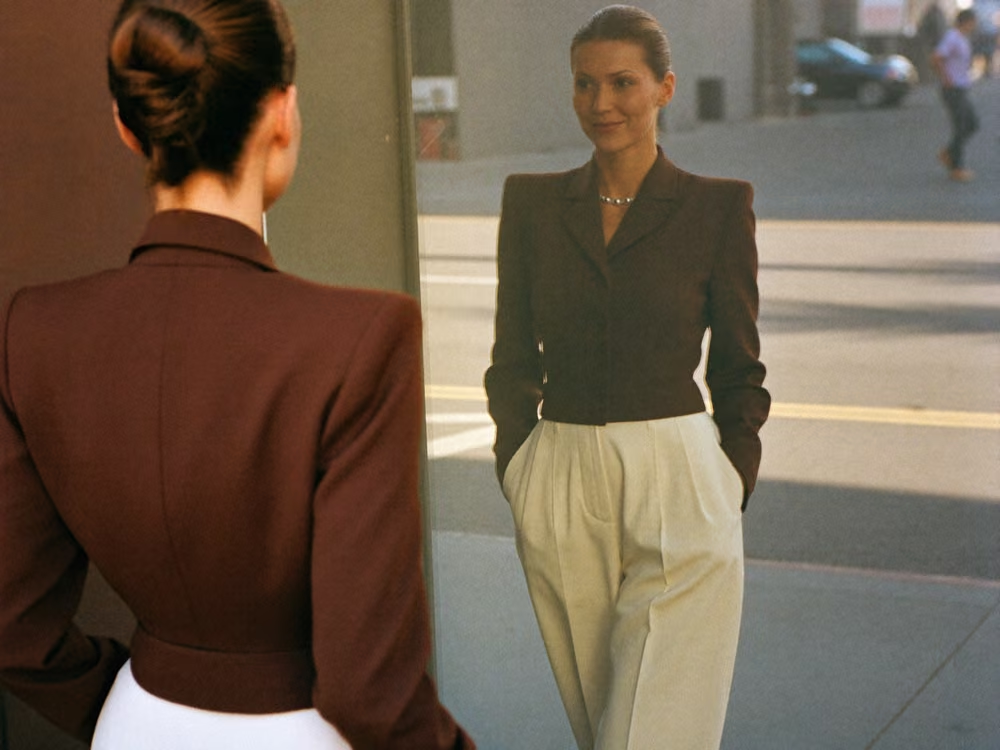
For modern fashion e-commerce, constant promotions have become not a tool to stimulate demand, but a severe addiction. Buyers have become so accustomed to crossed-out price tags that empty "Enter promo code" fields in the cart are perceived almost as a personal insult. As a result, a brand gets trapped in a vicious circle: traffic gets more expensive, customer acquisition cost (CAC) steadily rises, and the margin of every single deal tends to a minimum due to forced price dumping.
Owners of online clothing stores, opticians, and jewelry brands often see discounts as the only working lever to pressure a doubting user. But let's look at the situation from a different angle. A price reduction is merely financial compensation for the risk a customer takes when buying an item "blindly." If we eliminate this risk, the need to burn our own profit will disappear on its own.
To sell products at full price and simultaneously demonstrate a steady growth in conversion rate (CR), businesses must shift their focus from price competition to user experience competition. Augmented reality technologies and neural networks offer a fundamentally new approach — giving the customer confidence in their choice before the payment stage.
This article is part of our complete guide to fashion e-commerce sales and conversion optimization.
Why Don't Buyers Convert at Full Price?
The main enemy of a successful online transaction is doubt. In a physical boutique, the scenario is extremely simple: a person takes an item from a hanger, puts it on, and looks in the mirror. If the reflection evokes positive emotions, the purchase decision is made instantly, and the question of a discount fades into the background. The customer pays for confidence and emotion.
In the digital environment, the process is complicated by the visualization barrier. A user sees a luxurious bag, conceptual glasses, or a dress on a professional model with perfect lighting. At this moment, a complex risk assessment process launches in their head:
- Will this frame suit my face shape?
- Won't this bag look too massive for my height?
- How will this shade of metal on the jewelry match my skin tone?
- Will this cut fit my figure as well as it does the catalog model?
Cognitive load increases. The human brain dislikes uncertainty. A pause occurs, the customer saves the item to "Favorites" (from which they rarely return) or starts looking for coupons to justify a potential mistake with a financial benefit. If there is no promo code, the tab is closed. The retailer loses a warm lead, for whose click they have already paid the advertising system.
Conversion Economics: Why Experience is More Profitable Than Dumping
The discount model is destructive to unit economics. Many brands do not even realize how hard a 15% promo code hits their net profit, especially considering the costs of logistics, marketing, and acquiring.
Let's compare two paradigms of working with traffic.
Table: Comparison of Traffic Handling Strategies (Using an Example of 10,000 Visitors)
Metric | Strategy A (Warming up with discounts) | Strategy B (Virtual Try-On, full price) |
Base item price | $100 | $100 |
Discount size | 15% ($15) | 0% |
Actual check | $85 | $100 |
Cost of goods + expenses | $60 | $60 |
Net margin per unit | $25 | $40 |
Purchase conversion (CR) | 1.5% | 2.2% (due to engagement and barrier removal) |
Number of orders | 150 | 220 |
Total profit | $3,750 | $8,800 |
The figures in the table are provided to demonstrate the mechanics. In reality, the gap can be even more substantial, as a loyal audience that has received a wow-experience is prone to repeat purchases (LTV growth).
Virtual try-on allows you not just to abandon dumping, but to break through the glass ceiling of conversion, unattainable with a standard flat catalog.
These figures illustrate the principle, but implementation data tells an even clearer story. See our funnel-stage analysis of how an AI try-on widget multiplies conversion rates for benchmarks from product page to checkout.
The Psychology of Virtual Try-On (VTO): How Neural Networks Drive Sales
Integrating a virtual fitting room into a website is not just an image-building story or an entertaining feature. It is a powerful marketing tool that works on deep psychological patterns.
1. The Endowment Effect
Virtual try-on activates what behavioral economists call the “endowment effect” — when a shopper sees a product on her own photo, her brain encodes it as “already mine,” making the purchase feel like keeping rather than buying. We break down this and five other cognitive biases that shape fashion purchasing decisions in our dedicated article on the psychology of online shopping.
2. Radical Increase in Time-on-Site
Search engine and advertising platform algorithms closely monitor behavioral factors. If a person visits a site and spends 15 seconds there, it is a bounce. Virtual try-on turns the shopping process into a gamified experience. The user begins to sort through frames, change bag colors, and see how different styles look. The time spent on the site increases several times over. The longer a user interacts with a brand's product, the higher the chance of a successful transaction.
3. Removing the "First Step" Barrier
To place an order, a user must make a series of micro-efforts: choose a color, size, and enter card details. VTO shifts this process from a state of "work" to a state of "play." The customer relaxes, and the level of trust in the platform grows. They see that the brand invests in their convenience.
How the Looksy.tech AI Widget Works with Different Niches
The neural network architecture underlying the Looksy service is trained to recognize the smallest details of anatomy and space. This allows for photorealistic rendering of objects, which is critical for removing barriers when buying at full price. Let's break down how this works in different retail segments.
Eyewear and Optics: Surgical Precision of Fit
The hardest niche to sell online. A millimeter in the width of the bridge or the shape of the frame changes the whole face.
- Mechanics: The AI widget captures control points on the user's face in real time. Tracking works without delays when turning the head.
- Impact on CR: The customer sees the real proportions of the frame relative to their face. The fear of "I will look silly," which is usually cured only by a heavy discount, disappears. Payment is made confidently and at the original price.
Jewelry: Play of Light and Scale
Buying expensive jewelry online always has a high threshold for decision-making. A flat photograph does not convey the volume of a ring, the length of a pendant, or the shine of metal.
- Mechanics: Looksy allows you to try on earrings, necklaces, or rings through a smartphone camera. Algorithms take lighting into account, creating realistic highlights on virtual metal.
- Impact on CR: Demonstrating the jewelry directly on the customer's body creates that exact wow-effect. The user admires themselves, not an abstract picture, which stimulates spontaneous purchases in the high-end segment.
Bags and Accessories: Understanding Real Dimensions
A common e-commerce problem is a lack of understanding of product sizes. "Will a laptop fit in this shopper?", "Doesn't this clutch seem too small?".
- Mechanics: AR technologies allow projecting a bag into the user's real space. You can place it on a table, evaluate the texture of materials when zooming in, or virtually "take" it in your hand.
- Impact on CR: The key objection regarding the mismatch between expectations and reality is removed. Trust in the product converts into a successful payment.
Clothing: Focus on Silhouette and Cross-Sell
The Total Look mechanic is one of the most powerful AOV drivers in fashion e-commerce. For cross-sell scenarios and their revenue impact, see how virtual try-on stimulates cross-sell and increases average order value.
Selling clothes requires maximum personalization. It's important for customers to understand how an item behaves in motion.
- Mechanics: Virtual try-on allows overlaying the item onto the user's silhouette, evaluating sleeve length, shoulder fit, and the overall look of the garment.
- Impact on CR: In addition to direct sales of a specific item, the widget opens up colossal opportunities for cross-selling. A retailer can offer to try on a "Total Look" at once — for example, a dress complete with a matching bag and glasses. Seeing a complete, harmonious image on themselves, the customer adds the entire set to the cart much more often, radically increasing the average check.
Technological Implementation: Fast, Reliable, Invisible to Processes
With more than 70% of fashion traffic coming from smartphones, mobile performance is non-negotiable. We explore why try-on is particularly effective on mobile in our article on mobile shopping and virtual try-on as a conversion booster.
Many business owners postpone the implementation of AR technologies, fearing a long development cycle, astronomical estimates from IT departments, and the need to rewrite the site's architecture. This is a classic misconception shaped by the market of five years ago.
Today, launching neural networks on an online store's storefront doesn't require months of preparation. The Looksy.tech service is designed on a Plug-and-Play principle. This means that complex mathematical calculations, rendering of 3D models, and object tracking take place on the service's servers, without overloading your site or slowing it down (which is crucial for SEO and mobile traffic).
Stages of Launching VTO on Your Platform:
- Catalog Preparation: Selecting key items (flagship products or new arrivals) that need a sales boost.
- Digitizing Assets: Converting regular photographs or patterns into formats understandable by the neural network.
- Widget Installation: Adding a small snippet of code to product pages. The widget is compatible with the vast majority of popular CMS systems and custom builds.
- UI Customization: Adjusting the appearance of the try-on button to match your brand's corporate identity (colors, fonts), so the tool looks like a native part of the site.
All processes take a minimum amount of time. As a result, you get a technological interface that begins to collect statistics and generate additional sales literally within the first hours after release.
Transition from a Price War to a Value Proposition
Modern e-commerce is a highly competitive environment where dumping is a road to nowhere. Only global marketplaces burning budgets for market share can afford to compete on price. For an independent fashion brand, optician, or jewelry house, the key to stable profit lies in the service.
By forcing a customer to search for a promo code, you devalue your product. By offering a customer the innovative experience of virtual try-on, you highlight the brand's status and care for the buyer. A user who was able to examine an item in detail on themselves, evaluate the proportions, and fall in love with their new look will not open a neighboring tab for a discount. They will place the order right here and now.
The impact does not stop at the first purchase. Shoppers who experience a positive, personalized try-on return more frequently and spend more over time. See how virtual try-on drives repeat sales and customer lifetime value.
Submit a request for a demonstration of Looksy.tech's capabilities. Discover how to integrate advanced AI algorithms into your online store, and see how your storefront's conversion rate will grow in the very first month of operation without a single sale.
Request a LOOKSY Demo
Submit a request, and we will help you choose the LOOKSY format that best fits your business case.