The Psychology of Online Shopping. How Cognitive Biases Shape Every Fashion Purchase Decision
Six cognitive biases explain why fashion shoppers hesitate, abandon carts, and postpone decisions — and what stores can do about each one.
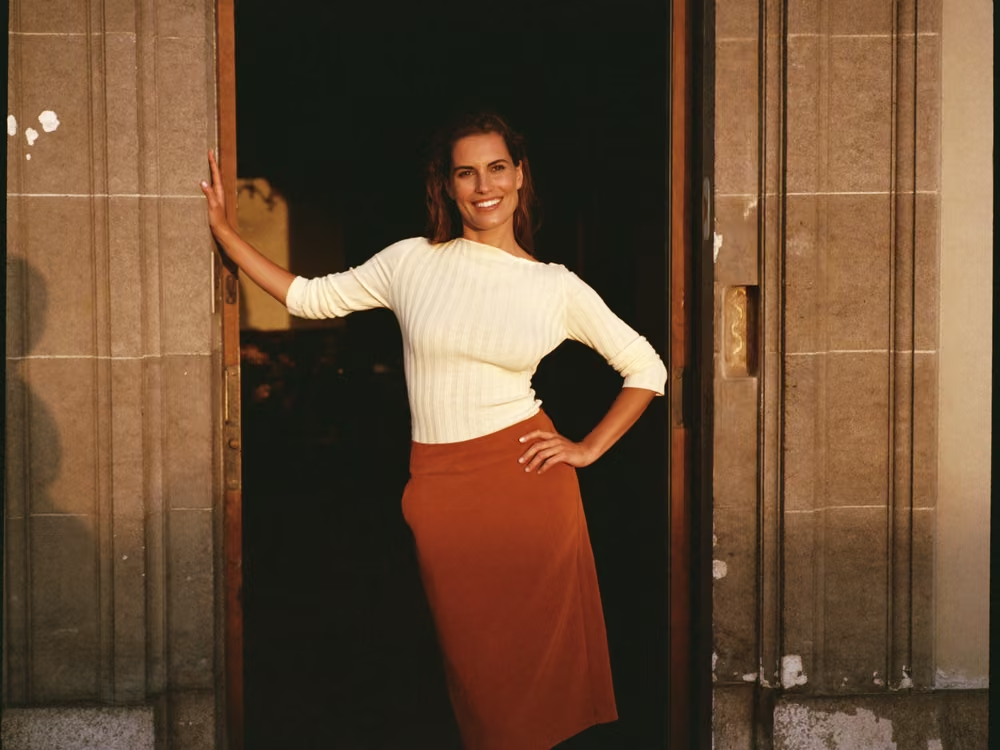
Fashion shoppers rarely leave a product page because they have made a clean, rational decision not to buy. More often, the decision remains unresolved. The product looks appealing, but the shopper cannot confidently connect the studio image with her own body, face, wardrobe, and daily life.
This article is part of our complete guide to boosting sales and reducing returns in fashion e-commerce. Here we isolate the behavioral mechanisms behind hesitation: six cognitive biases that turn uncertainty into abandoned product pages and carts.
1. The Imagination Gap: When the Brain Cannot Project
A product image gives the shopper visual information, but not personal evidence. The brain must translate a dress shown on one body, or glasses shown on one face, into a prediction about somebody entirely different. That projection requires effort and is vulnerable to doubt.
The harder the product is to evaluate — an unusual silhouette, a strong color, oversized proportions, statement jewelry — the wider the imagination gap becomes. More photography can show construction and texture, but it cannot fully answer “what will this do to my appearance?”
When the brain cannot form a stable prediction, it postpones the decision. Virtual try-on reduces the projection task by replacing imagination with a personalized visual reference. For the resulting impact on product-page and checkout metrics, see our funnel-stage conversion analysis.
2. The Endowment Effect: Ownership Changes Everything
Behavioral economists use the term endowment effect to describe our tendency to value something more once we feel that it belongs to us. Physical fitting rooms activate it naturally: putting on a jacket or holding a bag changes the frame from “an item I might buy” to “an item I am wearing.”
Online catalogs normally keep the shopper at a distance. She evaluates a model, not herself. A personalized try-on image closes part of that distance and lets the product enter her self-image before payment.
The purchase decision then feels less like acquiring an unfamiliar object and more like keeping a look that already works. The effect should not be treated as a guarantee, but it explains why personal visualization can be more persuasive than another product description.
3. Analysis Paralysis: The Tyranny of Choice
Choice creates value only while the shopper can compare alternatives. Barry Schwartz's paradox of choice describes what happens when more options increase the cost of deciding faster than they increase the chance of finding a better match.
Imagine a catalog with 80 eyewear frames. A large assortment sounds commercially attractive, but every frame introduces another comparison: shape, color, width, material, and price. Without a personal evaluation method, the shopper must remember abstract impressions across dozens of pages.
The imagination gap concerns one product: the shopper cannot predict how it will look. Analysis paralysis concerns the relationship between products: she cannot confidently rank the options. Together they make the “safe” decision — choosing nothing — increasingly attractive.
Virtual try-on turns a large assortment into a sequence of concrete comparisons. The shopper can reject obvious mismatches quickly and build a shortlist around outcomes rather than catalog descriptions.
4. Decision Fatigue and the “I'll Come Back Later” Trap
Decision quality deteriorates as cognitive effort accumulates. After comparing products, checking sizes, reading policies, and calculating delivery dates, postponement feels like relief. “Save to wishlist” often becomes a polite form of rejection rather than a real purchase plan; in many stores, fewer than 12% of wishlisted items convert.
The problem is not simply that the funnel contains many clicks. Each unresolved question creates another decision. A shopper who must keep evaluating appearance while also choosing size and delivery reaches fatigue faster.
Reducing the path to a confident visual answer preserves attention for the remaining commercial choices. The measurable effect appears in engaged time, product comparisons, and progression to cart; see how engagement through AI try-on turns visitors into buyers.
5. Social Proof Deficit: The Missing Fitting-Room Mirror
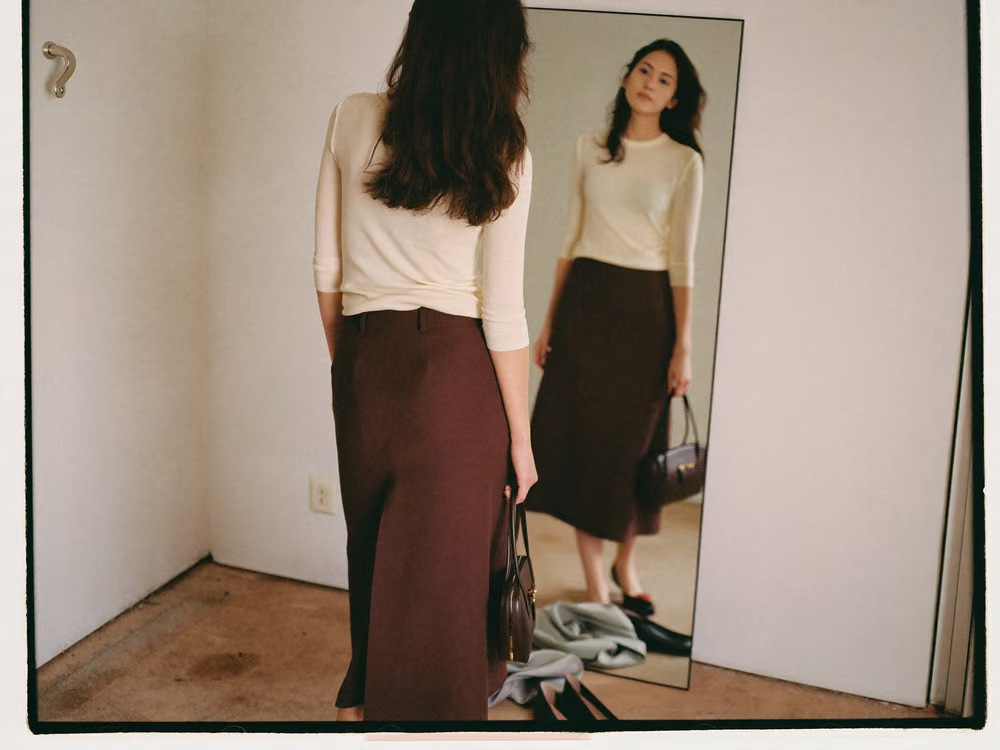
A physical fitting room rarely operates in isolation. A friend, partner, or sales associate reacts to the outfit, confirms that a color works, or challenges a poor choice. Even the mirror provides a familiar ritual in which the shopper evaluates herself rather than an anonymous model.
Online shopping removes that immediate validation. Reviews provide social proof about quality and fit, but they cannot respond to the shopper's specific appearance. The result is a social-proof deficit at the exact moment confidence is needed.
A shareable try-on image partially restores the missing loop. The shopper can ask somebody she trusts for an opinion using evidence tied to her own look. Sharing does not eliminate uncertainty, but it converts a private abstract doubt into a concrete conversation.
6. Loss Aversion in Reverse: The Fear of a Bad Purchase
Prospect theory, associated with Daniel Kahneman and Amos Tversky, shows that people often feel potential losses more strongly than equivalent gains. In fashion e-commerce, the “loss” appears before payment: wasted money, return logistics, disappointment, and the possibility that the item will not match expectations.
Free returns reduce the financial penalty but not the anticipated effort. They can also encourage bracketing — ordering multiple options with the intention of returning most of them — which moves uncertainty and cost from the product page into fulfillment.
A stronger strategy reduces the probability of a bad choice before the order. Better visualization and fit guidance make the expected outcome clearer, so the shopper needs less price compensation for risk. This is also why confidence can support conversion without burning margin on discounts.
What This Means for Your Store
These six biases compound. The imagination gap makes one item difficult to evaluate. A large assortment turns that difficulty into analysis paralysis. Repeated comparison creates decision fatigue. Missing social validation leaves the shopper alone with doubt. Loss aversion makes postponement feel safer. And without personal contact with the product, the endowment effect never begins.
The common denominator is uncertainty. Stores do not need a separate persuasion trick for every bias; they need better decision information at the moment each bias appears.
- Use personal visualization to narrow the imagination gap.
- Help shoppers compare outcomes rather than specifications.
- Reduce redundant choices and make the next step obvious.
- Make try-on results easy to save or share for validation.
- Explain fit, delivery, and returns before checkout.
- Measure what shoppers do after receiving reassurance.
These psychological shifts should produce measurable results across the e-commerce funnel, from add-to-cart to checkout completion. For the data, use our conversion-rate analysis. For the longer-term effect on customer behavior, see how virtual try-on supports repeat sales and LTV growth.
For a side-by-side comparison of standard product-page metrics and pages with virtual try-on, return to the funnel-stage breakdown. Psychology explains why a shopper moves; measurement tells you whether the intervention created commercial value.
Request a LOOKSY Demo
Submit a request, and we will help you choose the LOOKSY format that best fits your business case.